(407) 644-2676

1601 Lee Road,
Winter Park, FL 32789

Shop Online
Book Appointment

Emergency / Urgent Care

Scroll to WPVH top

Wildlife Resources


January 1, 2026

Dear WPVH Family,

For decades, Winter Park Veterinary Hospital has proudly provided direct medical care to wildlife in our local community, with the invaluable support of our long-standing wildlife partner, Mary Jane from The Haven for Injured and Orphaned Wildlife. After many years of dedicated service, Mary Jane retired on January 1, 2026. We are deeply grateful for her commitment and the lasting impact she has made on wildlife and our community.

With the retirement of our local rehabilitation partner, we have taken time to thoughtfully reevaluate how we can best serve and protect our friends in the wild. After careful discussion and consideration of what is truly best for the animals we all care about, we have decided to pivot our approach.

Moving forward, we will support wildlife in a new and more effective capacity by increasing our support for established local wildlife rehabilitators who specialize in returning animals safely to the wild. By eliminating Winter Park Veterinary Hospital as the “middleman,” animals can be connected directly with rehabilitators – resulting in:

  • Reduced stress for the animal
  • Faster diagnosis and treatment
  • A greater likelihood of survival and successful release

While we will no longer be directly admitting wildlife, our commitment to local wildlife remains strong. We will continue to support rehabilitators through financial contributions, medical guidance, and veterinary care when requested by licensed rehabilitators.

As a result, effective January 1, 2026, Winter Park Veterinary Hospital will no longer be accepting wildlife patients.

Thank you for your continued compassion, understanding, and dedication to animal welfare.

Sincerely,

William J. Hess Hospital Manager
Winter Park Veterinary Hospital

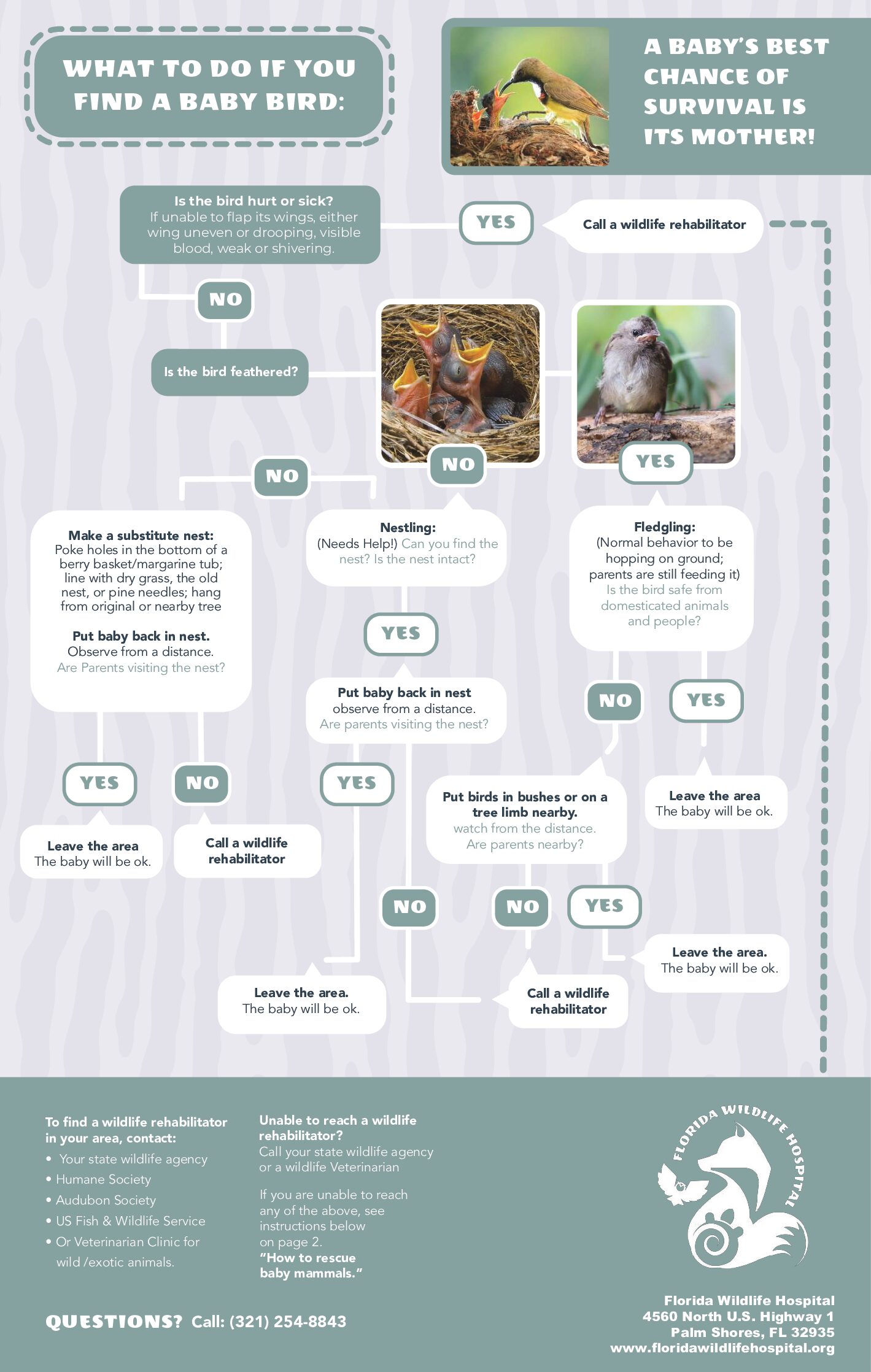
Florida Wildlife Hospital has wonderful resources on their website!

 https://floridawildlifehospital.org/found-animal/

FOLLOW THE LINK ABOVE FOR:

  • Species-specific rescue instructions

  • Guidance on whether an animal needs help

  • After-hours drop box available

Florida Wildlife Hospital
321-254-8843
4560 N. US Hwy 1, Palm Shores, FL 32935
https://floridawildlifehospital.org/found-animal/

Visit the website for more resources and information.

Doreen Allison – Malabar, FL
321-951-0889

  • Squirrels, opossums, rabbits, songbirds

  • Can help connect you with other local rehabbers

Little Bit Wildlife Rescue
561-270-9328
21141 Peckham Ave, Mount Dora, FL 32757

  • Raccoons, squirrels, bats, opossums

Back to Nature Wildlife Refuge
407-568-5138
10525 Clapp Simms Duda Rd
Orlando, FL 32832

  • Will take in orphaned and injured wildlife- INCLUDING BIRDS

Wildlife Rehabilitation Center of Central Florida
21117 Reindeer Road
Christmas, FL 32709
407-568-3200 (Carol Hardee)

  • Baby mammals only

  • No birds or adult mammals

  • Call ahead before arrival

Swamp Girl Adventures – Kim Terrington

  • All reptiles

Bellalago Veterinary Hospital
407-847-0802
3809 Pleasant Hill Rd, Kissimmee, FL 34746

  • Baby squirrels

  • Call ahead to confirm space availability

Samadhi Wildlife
386-290-3314 (text preferred; include photos and details)
289 Pine Woods Rd, Ormond Beach, FL 32174

  • Native Florida mammals only

Marine Science Center
100 Lighthouse Dr, Ponce Inlet, FL 32127

  • Birds found within Volusia County

Travis Roddenberry – Deltona, FL
386-561-1406

  • Mammals including squirrels, raccoons, and deer

  • Call ahead

About Florida Wildlife Hospital

The wildlife hospital is open 9:00am – 4:30pm every day of the week. If it is outside of business hours, please leave animals in the Drop Off Boxes and fill out the paperwork in the mailbox. The Drop Off Boxes are monitored by staff outside of business hours and are out of the weather, predator proof, and away from stressors like people and pets.

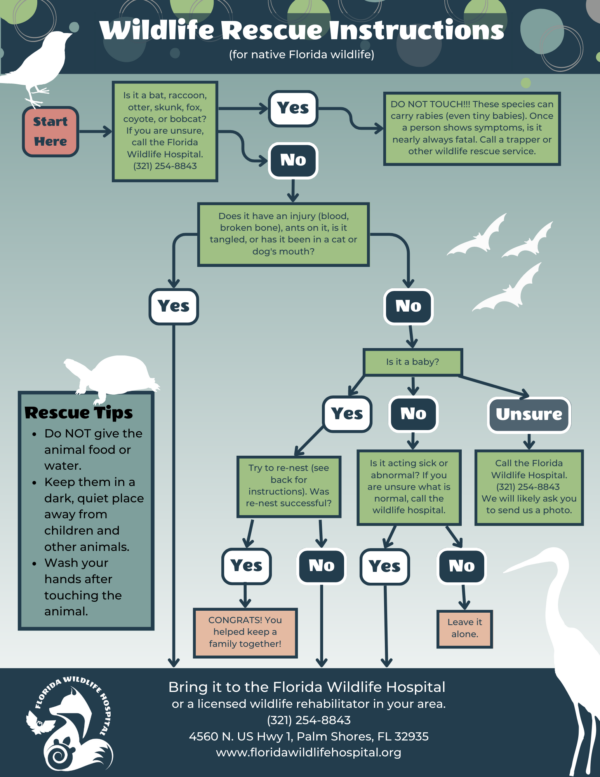
If you have found an animal, click the corresponding button for handling instructions.

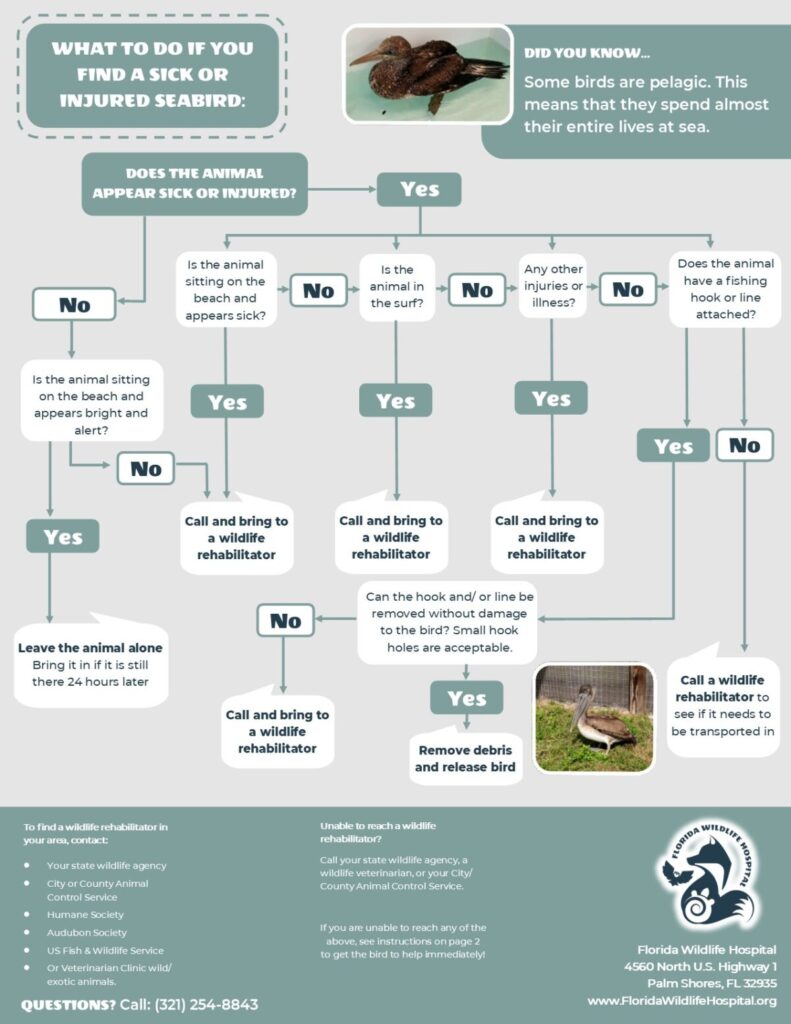
Flowchart-Seabird-JPG-1-1200x1553

Species Specific Information

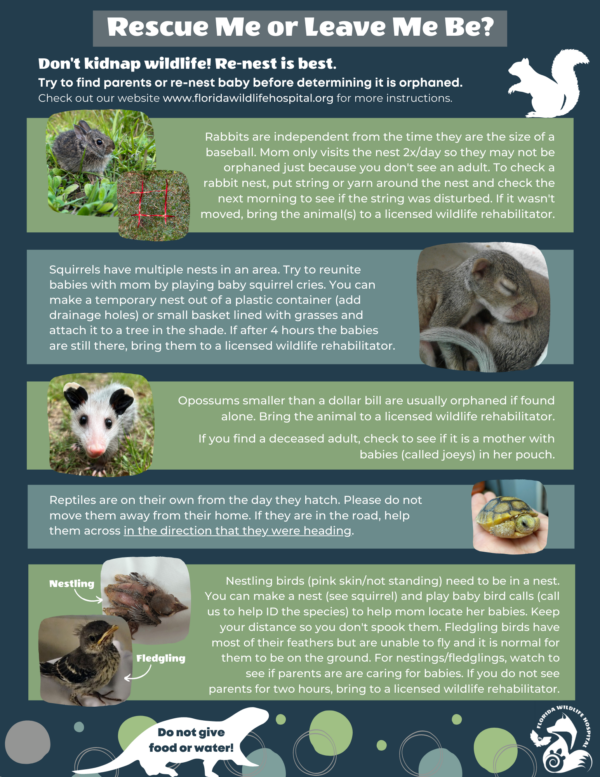
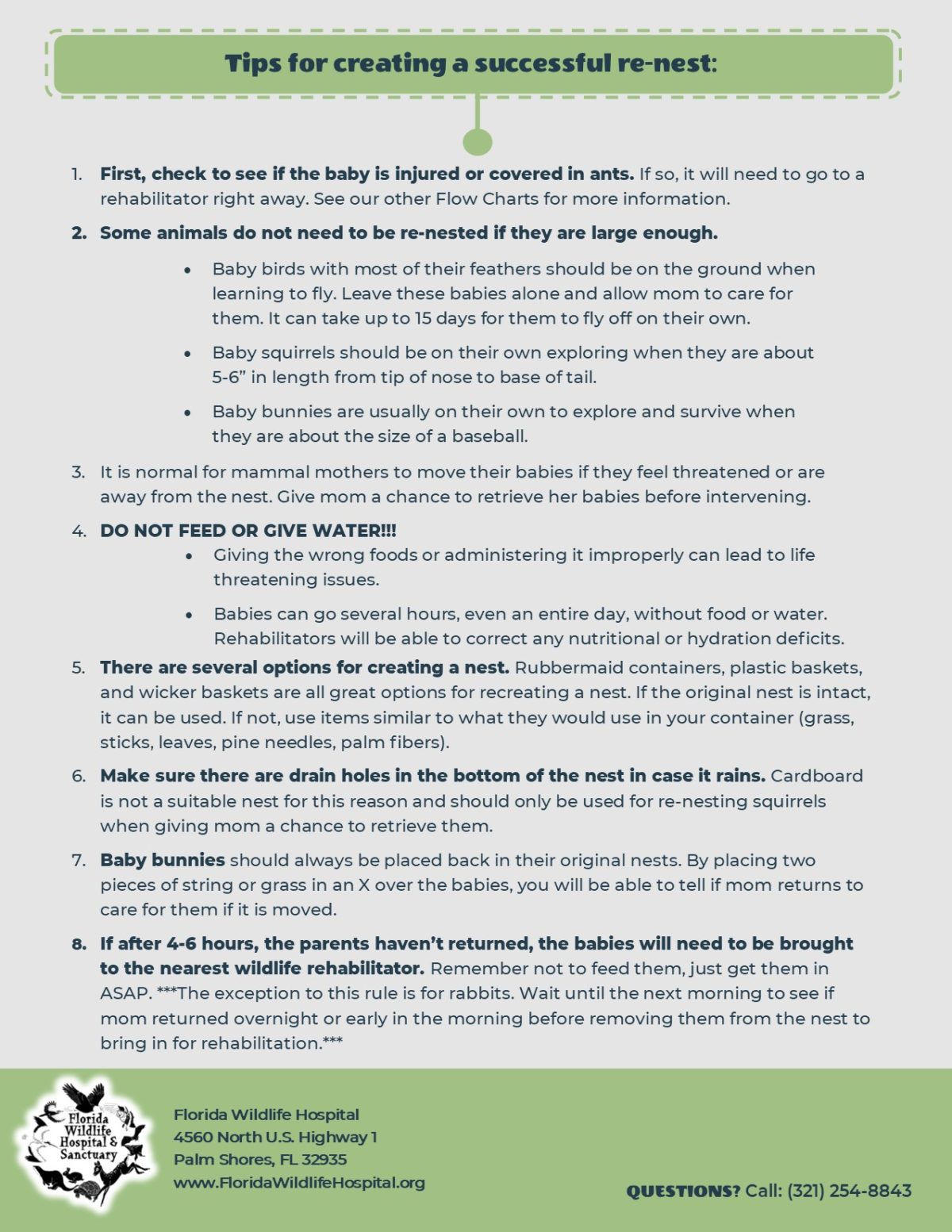
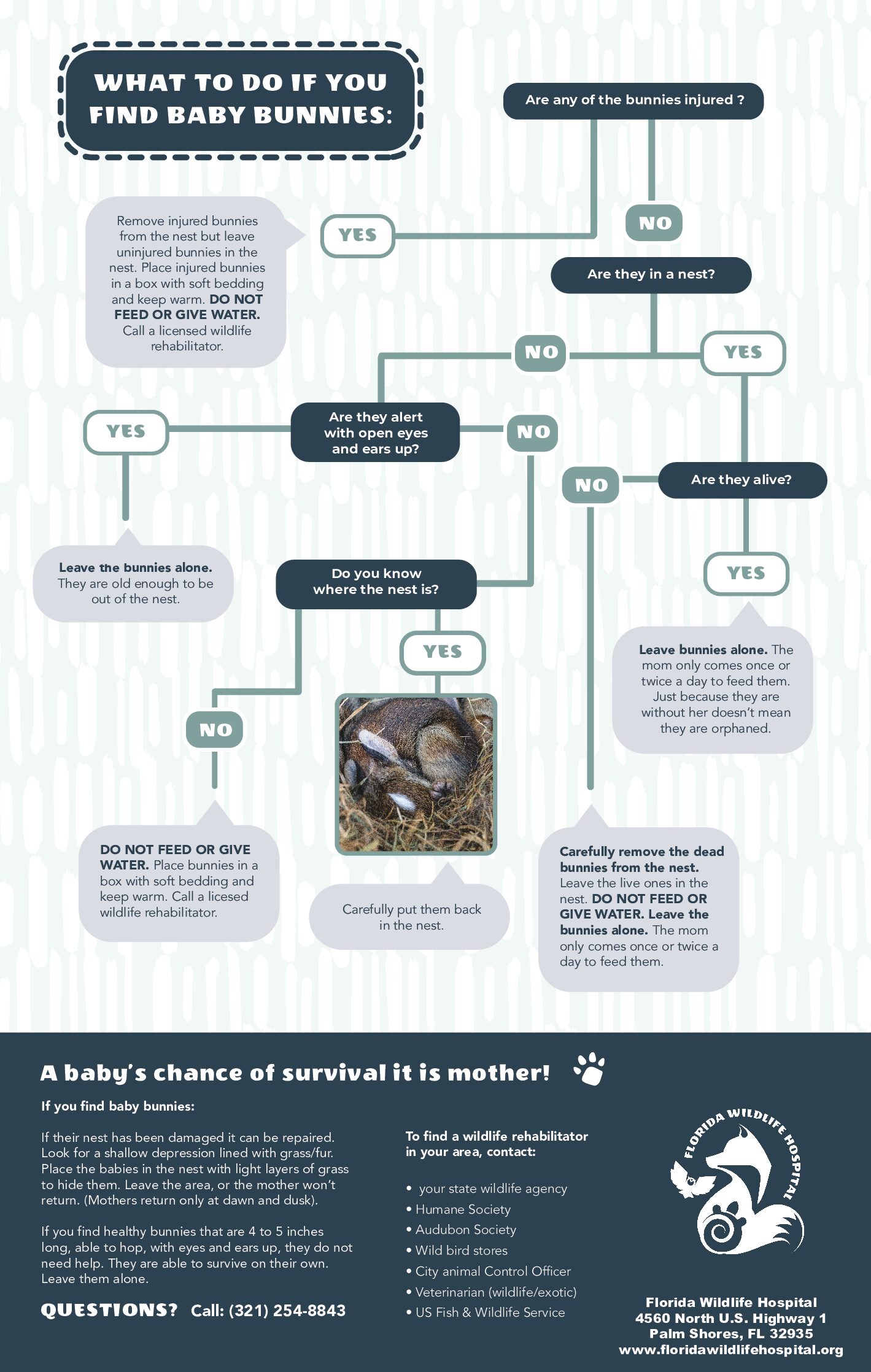
Baby bunnies are frequently kidnapped because mom only visits the nest twice a day to feed them and the rest of the time they are alone. If you are unsure whether the rabbits are truly orphaned, please refer to the flowchart below.

Flowchart – Bunny

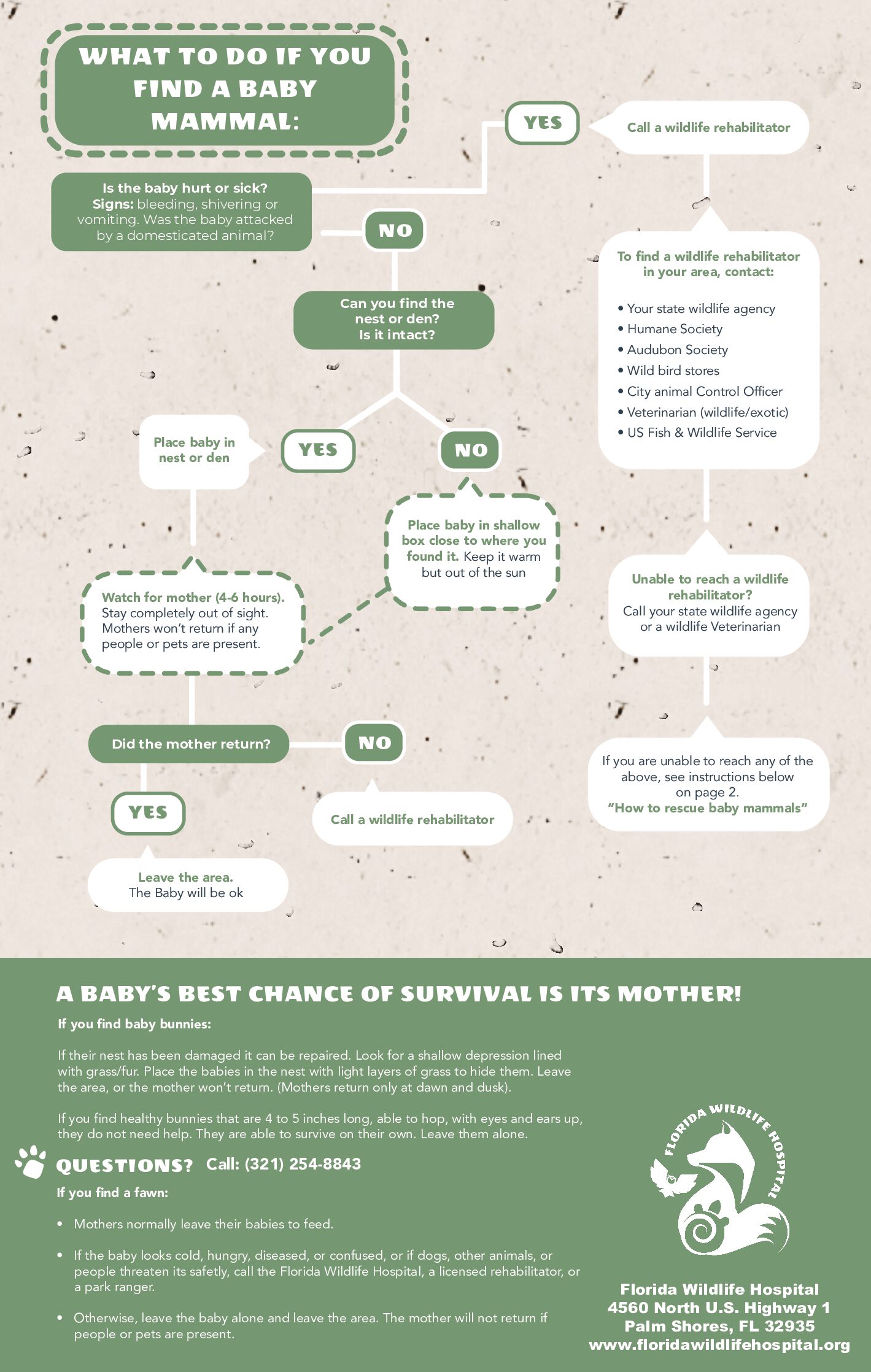
A baby animals best chance is to be reunited with it’s family. If you see blood, it is covered in bugs, or it has been in a cat or dog’s mouth, it needs to come to the wildlife hospital.

Squirrel – If it appears healthy, you can attempt to reunite it with it’s family before bringing it to the hospital. If you cannot reunite the squirrel with its family, please transport to the wildlife hospital in a small, secure box with air holes. You can use the baby squirrel sounds video below to help attract the parents back o the baby squirrel.

Opossum – If it is larger than a dollar bill (without the tail) it is old enough to be on its own. If it is smaller or not running away from you, please transport to the wildlife hospital in a small, secure box with air holes.
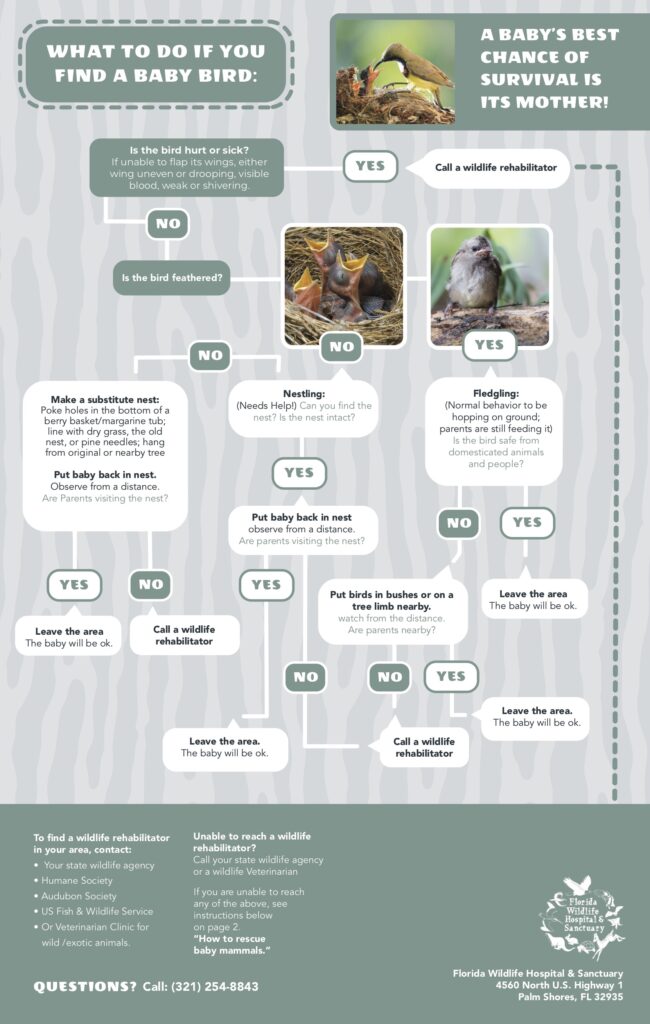
Flowchart – Mammal

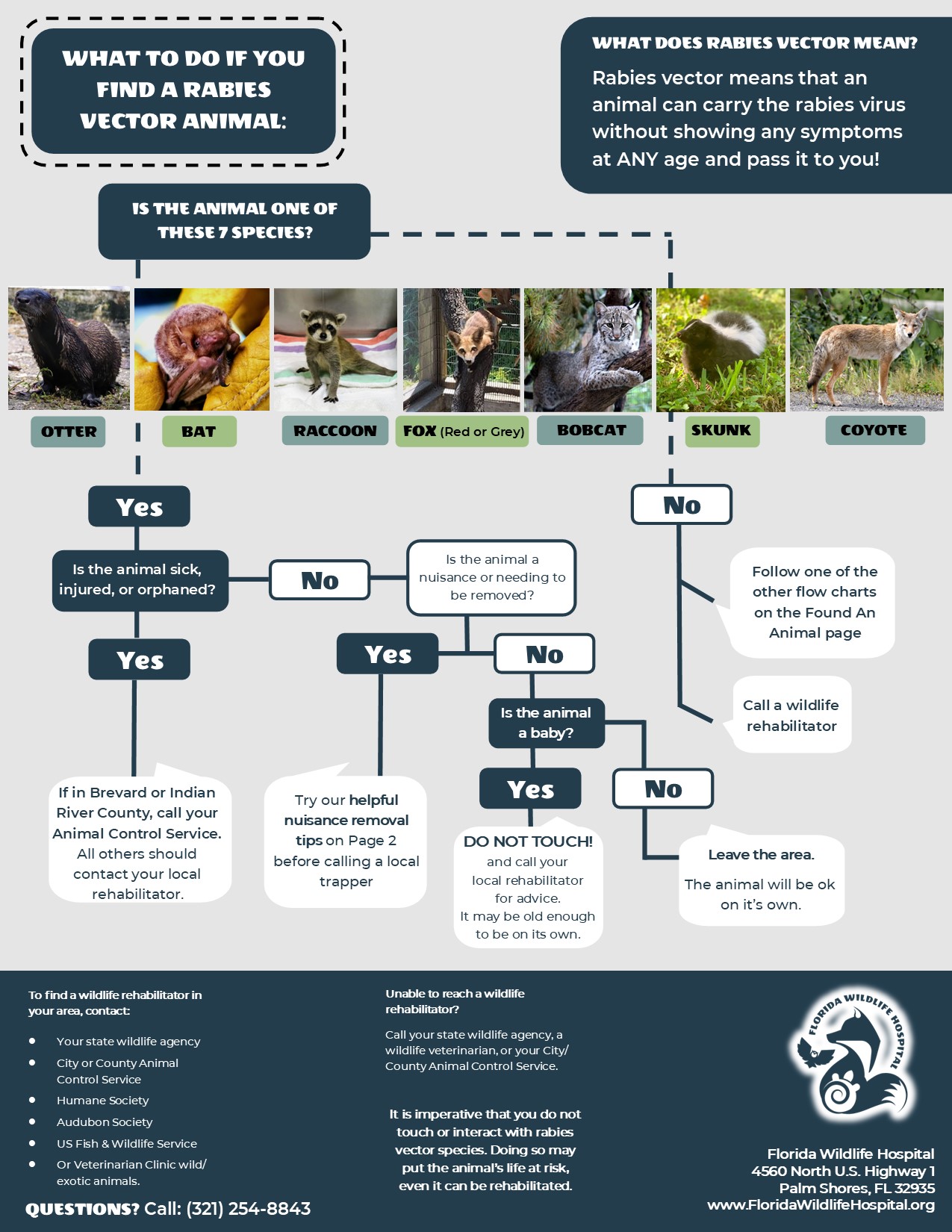
Rabies vector species are mammals that are more at risk for carrying the rabies virus (at ANY age, even babies). In Brevard County, this includes bats, otters, raccoons, skunks, coyotes, foxes, and bobcats. Please call BCSO Animal Services at (321) 633-2024, option 1. Any accidental exposure to rabies means certain death for the animal and possible expensive treatments for you. Do NOT attempt to transport a rabies vector species yourself.

Use heavy duty gloves such as welding gloves and transport in a box (plastic or cardboard) with a lid and air holes. If you have any questions about how to safely retrieve the animal, call our front desk at (321) 254-8843 or your nearest rehabilitator.

Use caution. Birds with long pointed beaks can stab and can cause serious injury. Birds with talons (owls, hawks, etc.) can cause serious injury. Gloves and eye protection are highly recommended. To transport, loosely cover the bird with a towel or sheet and place in a box or bin with air holes that can be securely closed. Pelagic birds like pelicans and gannets should not be held with their beak shut as their nares (nostrils) are permanently closed and this can make it difficult for them to breathe.

If you find a turtle or tortoise in the road, please assist it across the road in the direction it is heading. If it is not sick or injured, it does not need to come to the hospital.

To transport, lift gently by grabbing the middle of the shell and put in a box for transport. If it is a softshell or snapping turtle use extra caution as these turtles have long necks that can reach back and bite. If possible use an object to push them into the box or at least have heavy gloves. All turtles and tortoises have claws that can scratch.

Turtle Identification Guide

Do not attempt to approach or handle any venomous snake! To transport non-venomous snakes, put in an old pillow case and close with a rubber band or knot. Then place in a box with air holes or no lid.

Florida Museum – Identify a Florida Snake